


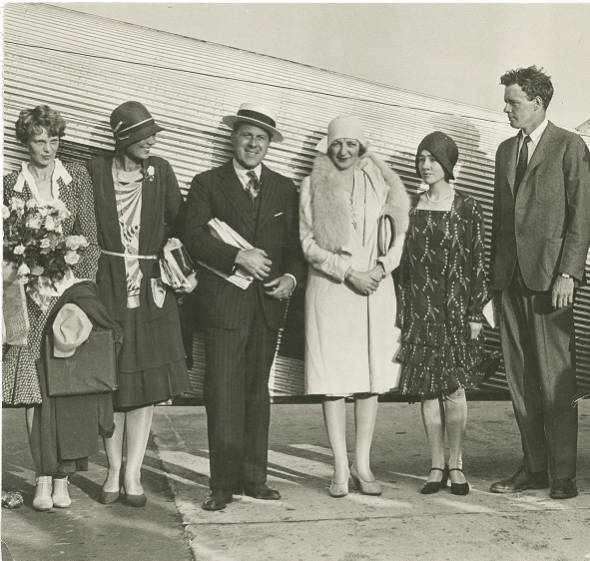
The Company We Keep: Amelia & Anne Lindbergh
I awake in a panic. What if Amelia was a Nazi?
I don’t want to uncover that about my heroine.
But by the transitive property of friendship, she certainly could be. We now know that Charles Lindbergh was a Nazi, and his wife Anne, also a pilot, is at the very least MARRIED to a Nazi, and if then Amelia who is friends with Anne, is in that social circle… you see where this leads. We also have reason to believe that Amelia and Anne were quite close.
You only need to read or listen to this passage from Amelia’s book The Fun of It.
“Perhaps no woman flyer is more interesting than Anne Lindbergh. That is because of her own personality, the fame of her husband, and the way in which she has tackled flying.
Anne Lindbergh is an extremely gentle person, essentially modest, totally lacking mannerisms, pretenses and superiorities. She is small, yet she has a charming dignity when surrounded by people. Most notable of her physical features are her large blue eyes which look out from long lashes, often with a quizzical gleam, directly and frankly at everyone—except perhaps news photographers! Her bobbed brown hair is combed back in a natural wave from a wide intelligent forehead. Her skin is fair and clear. About her mouth a smile always seems to lurk.
Her dress is simple, like her direct manners. As pilot or passenger, she shuns affectations. Ordinary street or sport clothes suffice, except when she plans to fly in an open cockpit where cold makes flying suits more comfortable. Then, her diminutive figure engulfed in ungainly togs, she looks like a tiny teddy bear beside her six-foot-something husband.”
Gentle reader, can’t you just hear her gently tucking a curl behind Anne’s ear and cupping her cheek in her palm?
She continues:
“Mrs. Lindbergh is an unusual person but not mysterious. She does what she wishes. She reads, writes, and drives her own car. She slips out of the house when she pleases and goes where she pleases. I do not know what games, if any, she likes or what sports.”
Contrast that intro with three other contemporary female aviatrix Amelia commemorated in text to level set against that effusive tribute:
- Ruth Nichols – “…always dresses with charm and distinction. Even in the air she is apt to be garbed in her favorite color, which happens to be purple, and she owns a specially made purple leather flying suit and helmet.” Got it. Ruth = Purple.
- Miss Smith – “…clothes can usually be counted on for a surprise. She is apt to wear whatever fancy or comfort of the moment dictates. At air meets I have seen her in costumes that range from conventional riding breeches to bright red beach overalls or shorts.” Miss Smith = Red.
- Laura Ingalls – “One of the most picturesque of present-day women flyers is diminutive Laura (not that one) Ingalls. She started to learn to fly at an eastern field, as I understand, but the instructors there discouraged her. They tried, at least. But Miss Ingalls doesn’t stay discouraged long. So she transferred her activities to another school and thence in due course emerged with a license.” Laura = Short and Gritty.
So…About That Nazi Thing
Cue another research rabbit hole.
Ultimately, I concluded that, yes, Colonel Lindbergh was definitely a Nazi or at least a Nazi sympathizer.
In 1940, over a year prior to Lindbergh’s “cancellation,” FDR told Henry Morgenthau, Jr., “If I should die tomorrow, I want you to know this: I am absolutely convinced Lindbergh is a Nazi.”
His wife Anne has been described as an “admirer of Hitler,” and some unfortunate quotes can be attributed to her that at the very least would qualify her as Nazi-curious.
There was, sadly, a strong contingent of supporters of Hitler in the United States in the 1930s as well as those who weren’t necessarily pro-Nazi, but anti-WW2-involvement. They pushed back on us entering WW2 until late in 1941. To learn more about our rich American Nazi traditions, check out Rachel Maddow’s excellent podcast, Ultra.
Why Amelia Was Firmly Anti-Hitler
One of the founders of Spinsters Row, Sue Separk, boasts a familial connection to this historic couple. Her Great Aunt Lucy was a classmate, close friend, and spirited partner-in-crime of Anne Lindberg at Smith College. Great Aunt Lucy was definitely NOT a fan of Hitler.
And just to be hilariously clear: everyone at Spinsters Row is firmly anti-Hitler.
You know who else wasn’t a fan of Hitler, lending more credence to Amelia’s place on the right side of history? Her husband, George Putnam.
His publishing company released a book entitled The Man Who Killed Hitler, anonymously, and he claimed that two German men came to his home, kidnapped him and attempted to uncover the name of the author. They eventually released him unharmed, and some claimed it was a publicity stunt. The less generous view of this is that while Hitler may have found some fans in the 30s, by the 40s, it became clear to which side to cleave.
What This All Means
Earhart is a perfect example of how even the greatest stars among us, are still part of a wider ecosystem that can shoot someone into the stratosphere or wink them out in a blink. Follow her biographical journey and you see the seeds of what made her:
- a family focused on education and reading,
- moving a lot which required the constant building and rebuilding of social networks
- her father’s affiliation with the rail industry that provided a blueprint for what an aeronautics industry could look like,
- a personal curiosity of physics, mechanics, electronics, weather and maps
- and the requisite classic T-type personality markers.
But what made Amelia’s greatest achievements possible was the stroke of fortune that timed her arrival on Earth just as major breakthroughs in meteorology, photography, radio communications, publishing, and advertising were occurring. Combined with the military weapons’ research post WW1, humans were changing the way they interacted with their world and with each other.
Like all of us, Amelia was complex, multi-faceted, and on a journey to discover her own boundaries and those that society attempts to place on us. Sometimes I’m saddened we lost her before her 40th birthday, but mostly I’m amazed at what she was able to accomplish so quickly and so deftly.
And SOME days, I feel a sense of pride, as I too am juggling a lot while wearing comfortable separates, daydreaming about leaving gravity behind, and striving for the next sunrise.
I think Amelia would be pleased.


