


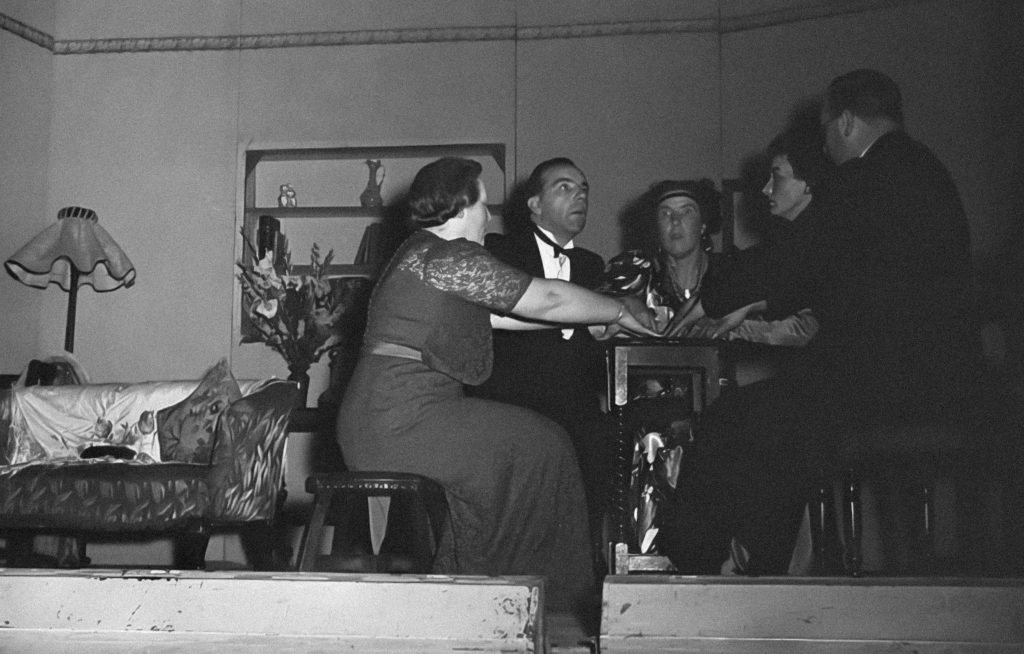
Séances have become a horror movie trope, featuring prominently in modern classics like Hereditary (a movie I refuse to watch again), The Others, and Beetlejuice, among many others. Ouija boards and the creepy embalmed hand in Talk to Me are also a variation on séances, as they represent a means of communicating with the dead — often with not-so-ideal results. If horror movies were fables, their shared lesson would be this: that attempting to talk to the dead is always playing with fire, and you’re sure to get burned… or at least haunted by an evil spirit that may or may not resemble a wan Victorian child in a lacy white nightgown.
So, where did séances come from? Cultures around the world have always devised methods for communicating with the dead, from ancient Egyptians who received messages from akhs to the Nekromanteion, a temple in ancient Greece where the faithful could come to talk to their dead ancestors. Today though, we’ll be focused on the séances that rose in popularity in the 19th century as a part of the Spiritualist movement that hinged on the permeability of the “spirit world” and our ability to bridge the gap between our world and the supernatural one.
The Fox Sisters: Teenage Pranksters Turned Mediums
The birth of the Spiritualist movement is often credited to the Fox sisters, Maggie and Kate, two teenagers from Hydesville, New York, who claimed that a spirit was communicating with them via raps on the walls and furniture of their home. The adults in their lives, including their parents and neighbors, bought into the prank and word began to spread that Maggie and Kate Fox had a special gift for communing with the dead. The sisters went on to perform for enormous crowds, holding public demonstrations of their powers as mediums.
Forty years later, Maggie Fox confessed that there were never any ghosts — the girls had made those noises by cracking their knuckles and other joints — but that original prank spun out of control and led to the creation of a whole religious and spiritual movement. They captured the attention of a populace that was desperate to connect with their loved ones, especially children who had been lost too soon. In the mid 19th century, it was estimated that 20-40% of children died before the age of five, which meant that there was no shortage of grief-stricken parents willing to pay top dollar to be assured that their child’s spirit was at peace. This was also an era in which death and mourning rituals were especially elaborate, with mourning portraits and jewelry in vogue to serve as remembrance for the deceased.
The Art of the Séance and Those Behind The Curtain

1882
As a movement, spiritualism was incredibly attractive to women, since a core belief of the movement was that women made better mediums than men:
“And it is no accident that Spiritualism, a movement which privileged women and took them seriously, attracted so many female believers during a period of gender disjunction and disparity between aspiration and reality. Spiritualist culture held possibilities for attention, opportunity, and status denied elsewhere. In certain circumstances, it could also provide a means of circumventing rigid nineteenth-century class and gender norms. More importantly, it did so without mounting a direct attack on the status quo.”
There was not a single “right” way to run a séance, but they tended to have the same elements: a spiritualist (usually a woman medium) who could speak to the dead, a circular table, lit candles, and red drapery that was conducive to spirit communication. Séances typically began with a short call or prayer to the spirits in question, and participants were told to hold hands around the table while oil lamps were dimmed. Then they waited for spirits to communicate — whether through the medium or disembodied noises and whispers.
Running a successful séance (and fooling one’s paying customers) often required literal people behind the curtain. Spiritualists often hired actors and ventriloquists to whisper from a corner of the room or even hid children in chimneys to make rapping noises at appropriately dramatic moments. This, it goes without saying, all went down before child labor laws.
They also had am impressive arsenal of tools of the trade at their disposal. Some tricks up their frilly sleeves included:
- “Ectoplasm” made of flour, water, and cornstarch that would leak from the spiritualist’s body when they were supposedly possessed
- Candles with the deceased’s perfume or cologne embedded into the wax
- Invisible ink for writing messages that would magically appear at an opportune time
- Spirit horns, which were simply paper or wooden cones that spiritualists would hold up to their ears to “hear” messages from the beyond
- Photographs faked to superimpose images of ghostly visitors over the séance table
Séances for the Rich and Famous
It wasn’t just normal, everyday people who were dazzled by the promise of being able to speak to their deceased loved ones. First Lady Mary Todd Lincoln had suffered much loss in her life, including her mother and three out of four of her children. When her second youngest son, Willie, passed away in 1862 at the age of 11, she was inconsolable and reached out to the Lauries, a group of mediums. They began hosting séances in the Red Room of the White House. In fact, there is evidence to show that as many as eight séances happened in the White House during this time period, and that President Abraham Lincoln was even present for several.
The séances, whether a hoax or not, provided Mary with some solace in her time of grief. As she relayed to her half-sister, the séances convinced her that, “Willie Lives. He comes to me every night and stands at the foot of the bed with the same sweet adorable smile that he always has had. He does not always come alone. Little Eddie [her son that perished at the age of four] is sometimes with him.”
Plenty of other famous people of the time attended séances as well, including Mark Twain, Frederick Douglass, and even Queen Victoria herself.
How Séances Live in Our Popular Imagination
The Spiritualist movement may have declined after the 1920s due to allegations of fraud and the rise of scientific skepticism, but it continues to leave an indelible impression on our collective psyche. Even the fact that we often imagine ghosts as figures clad in spooky Victorian garb can be traced directly to this era.


