


When Pride Collections Felt Like Visibility
There was a period of my life when seeing Pride collections in stores felt almost magical. In June, the rainbow displays would appear in windows and at the front of big box stores, and even before I fully understood myself, some part of me reacted to them. It was visibility that I didn’t know I needed and that mattered more than I can explain.
The Problem With Rainbow Washing
As I got older, though, my feelings about corporate Pride started to sour. Once you learn the term “rainbow washing,” it becomes difficult to unsee it. Companies drape themselves in rainbow branding for thirty days while donating to anti-LGBTQ politicians, underpaying queer employees, or quietly abandoning those same communities the second the cultural tides shift. Pride became marketable. Sanitized. Safe. Aestheticized into cheerful gradients and vague slogans about love while stripping away the anger, resistance, and danger that created Pride in the first place.
And then came 2025.
As DEI initiatives were rolled back across the United States, a lot of corporations revealed exactly how conditional their support had always been. Pride collections disappeared. Partnerships quietly evaporated. Statements about inclusion became noticeably shorter and harder to find. Companies that had spent years presenting themselves as allies suddenly folded the second allyship became inconvenient.
Why the 2026 Levi’s Pride Collection Feels Different
I think that’s part of why the 2026 Levi’s Pride collection has hit me so hard.
Instead of leaning into sanitized rainbow minimalism, the 2026 Levi’s Pride collection draws inspiration from queer motorcycle culture and queer leather history. Worn leather. Heavy hardware. A gritier aesthetic that feels connected to actual queer subcultures instead of focus-grouped for corporate optimism.
And for me personally, as someone connected to queer biker community, it feels familiar in a way most Pride collections never do. But what I love most is that it feels rooted in history.
The History of Dykes on Bikes and Queer Motorcycle Culture
Pride did not begin as a brand collaboration. It began as a riot. It began with people who were considered too loud, too political, too sexual, too masculine, too feminine, too transgressive, too much. The queer biker community has always carried some of that energy — protective, defiant, impossible to ignore.
In 1976, a small group of around 20 to 25 women motorcyclists gathered at the front of the San Francisco Gay Freedom Day Parade, now known as the San Francisco Pride Parade. That moment became the beginning of what the world would come to know as Dykes on Bikes®.
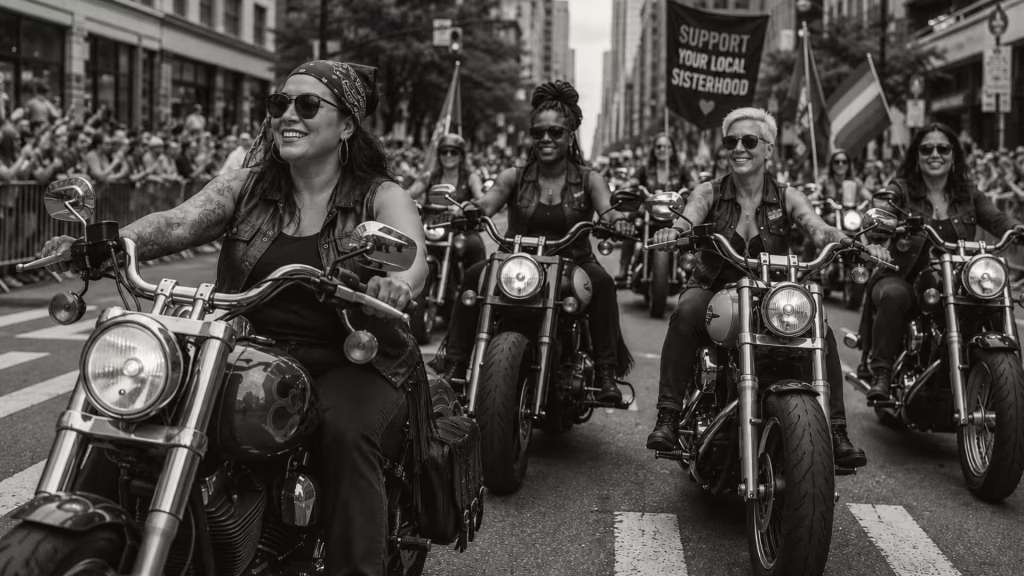
Originally, they moved to the front for practical reasons — motorcycles don’t love inching along at walking speed — but the symbolism stuck. The roar of engines became part of Pride itself. Loud. Unapologetic. Protective. Defiant.
Today, many Pride parades still begin with queer women riders leading the way. It’s one of those traditions that can look fun and celebratory on the surface while carrying decades of history underneath it.
Symbols That Refuse to Disappear
In a similar nod to queer history this Levi’s collection also uses the pink triangle. Before it was reclaimed by queer activists in the 1970’s, the pink triangle was used by the Nazis to identify and persecute gay men in concentration camps. Over time, it became a symbol of remembrance, resistance, and survival — proof that queer people were still here despite every attempt to erase them.
Seeing this symbol return in 2026 hits differently than it might have a decade ago. At a moment when LGBTQ rights are once again being debated, restricted, and politicized, the pink triangle doesn’t feel like retro aesthetic inspiration. It feels like a warning from history. A reminder that Pride began as survival.
Recognition Still Matters
And maybe that’s what I’ve been missing from so much modern Pride merchandising. History. Texture. Community. Specificity.
Not every queer person connects to glitter, rainbows and corporate slogans. Some of us connect to battered leather jackets, motorcycle patches, smoky bars, riot history, found family, and the people who stood between our communities and violence when nobody else would.
That doesn’t magically erase the complicated reality of corporate Pride. A clothing collection is still a clothing collection. Corporations are still corporations. But I think there is a difference between empty rainbow branding and work that genuinely engages with queer history and culture.
Maybe that’s why this collection feels less like being marketed to and more like being recognized.
And honestly? In this particular moment, recognition still matters.


One Response
Thank you for your message